Before the formal study of economics, the world was governed by the zero-sum game of Mercantilism. Nations measured their wealth in gold reserves, and trade was a weapon of war.
Global commerce was driven by navigation and conquest. Cities like London, Amsterdam, and Paris were the nodes of a chaotic network, funneling resources from the colonies to the metropole.
Kings believed that to get rich, they had to sell more than they bought. Tariffs were high, and the East India Companies dominated trade routes with state-sanctioned monopolies.
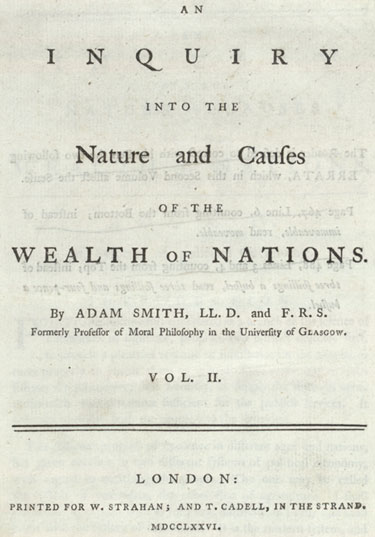
In Scotland, a moral philosopher named Adam Smith published The Wealth of Nations. He argued that the wealth of a nation wasn't its gold, but the goods and services it produced for its people.
Smith opened his book with a humble example. A single worker, untrained, could barely make a pin a day. But divide the task into 18 distinct operations—drawing the wire, cutting it, sharpening the point—ten men can make 48,000 pins.
Specialization was the engine of productivity that would launch the Industrial Revolution.
"It is not from the benevolence of the butcher, the brewer, or the baker that we expect our dinner, but from their regard to their own interest."
Smith didn't rely on altruism. He saw that in a free market, pursuing your own profit forces you to serve the needs of others.
Without a central planner, how does a city get fed? Prices act as signals. If people want more bread, the price rises, signaling bakers to bake more. Supply meets demand, and the market clears at an equilibrium.
Decades later, David Ricardo faced a harder question. If Britain is better at making everything than Portugal—both cloth and wine—should they still trade? Common sense said no. Ricardo proved yes.
Even if Britain has an absolute advantage in both, it gives up less wine to make cloth than Portugal does. It has a comparative advantage in Cloth.
By specializing in what they do relatively best and trading for the rest, both nations can consume outside their production possibilities frontier.
Use the controls on the left to adjust productivity and see how trade expands the consumption possibilities for both nations.
While Smith and Ricardo saw harmony, Karl Marx saw exploitation. As industrialization roared, he argued that the "Invisible Hand" was actually an iron fist, crushing the working class.
Marx argued that all value comes from labor. A worker spends part of the day earning their keep ("necessary labor"). The rest of the day, they work for free, generating "surplus value" that the capitalist pockets as profit.
Marx predicted the system would eat itself. Competition would force capitalists to cut wages and replace workers with machines, leading to falling profits and underconsumption. The revolution, he believed, was inevitable.
In the late 19th century, economics became mathematical. Léon Walras imagined the entire economy as a giant system of simultaneous equations.
How do we find the right prices? Walras proposed a theoretical "auctioneer" who calls out prices, checks for excess supply or demand, and adjusts them until everything clears.
Alfred Marshall synthesized this into the diagram we use today. Price isn't determined just by cost (supply) or utility (demand), but by both—cutting like the two blades of a pair of scissors.
Equilibrium is static, but the world is dynamic. Joseph Schumpeter argued that the true hero of capitalism isn't the price mechanism, but the Entrepreneur.
New technologies—steam, electricity, chemicals—don't just add to the economy; they destroy the old order. This "Creative Destruction" is the painful but necessary engine of progress.
The economy isn't a machine; it's an ecosystem. Industries rise and fall like species, driven by the mutation of innovation and the selection of the market.
For over a century, the Classical model reigned supreme. It promised that markets were self-correcting, that supply created its own demand, and that prolonged unemployment was impossible.
Then came the Great Crash. Banks failed. Production collapsed. Unemployment soared to 25%. The "Invisible Hand" had stopped moving, and the self-correcting mechanisms were nowhere to be found.
The world was trapped in a Great Depression that the old theories couldn't explain or fix. Economics needed a revolution. It was time for John Maynard Keynes.