An instrument earns trust.
Its image acquires a life of its own.
Time,
kept.
Fourteen seconds and the making of the Moonwatch.
Follow the record. Read the mechanism.
Then watch one exterior come apart.
Find your way around
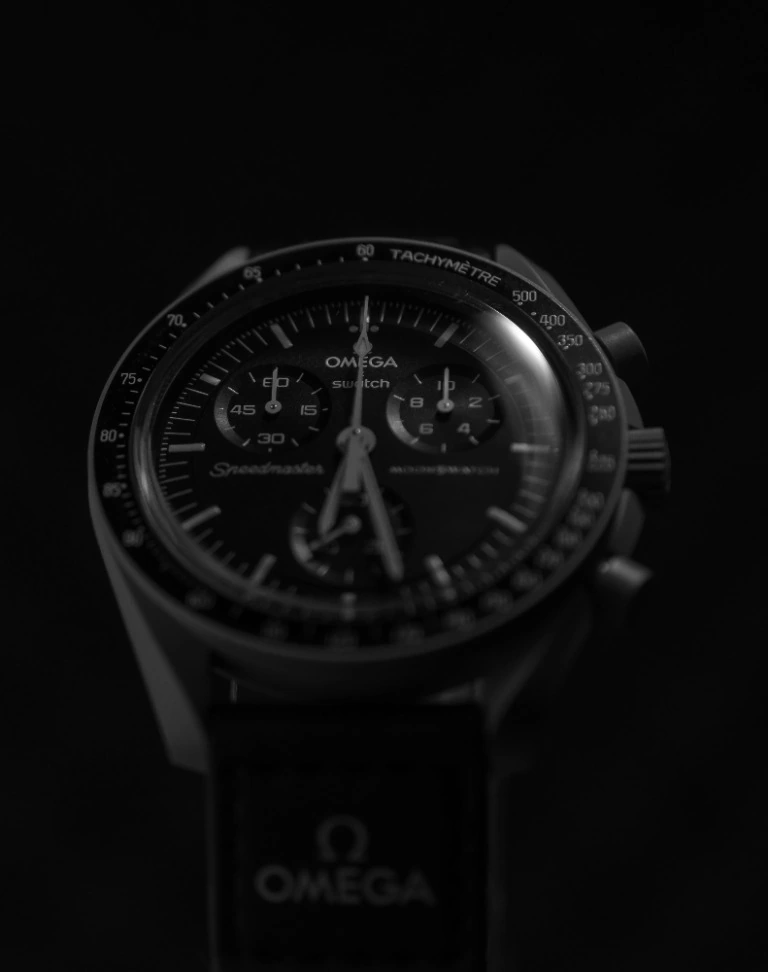
Photo: Dennis Mettler / Unsplash · License
Apollo 13 report; not a timing tolerance.
A retrospective protocol summary.
Two identified 3861 configurations.
My watch's exact reference remains unconfirmed.
A stopwatch becomes dependable through testing and practiced use. Its history becomes valuable through something more complicated. Follow the record from a measured mile to a mission procedure, then watch an exterior separate onto a watchmaker's tray.
I bought my Speedmaster with part of my grandmother's inheritance. That is the personal starting point of this story, not evidence about the performance of the watch.
Find your
way around.
Eight chapters around one object. Follow the sequence, jump to the evidence, or go straight to the deconstruction. The hand follows your reading.
- 01An intervalFourteen seconds. Read the whole procedure.
- 02The instrumentThe bezel does the division. You supply the distance.
- 03The test benchEleven tests. No universal stress score.
- 04Mission elapsed timeThe watch was one part of a working system.
- 05The object, openedTake it apart. Keep the limits in view.
- 06Continuity and changeFamiliar outside does not mean unchanged inside.
- 07What a number meansA million beats is arithmetic, not a million observations.
- 08History and scarcityFour kinds of quantity. No invented price curve.
Fourteen seconds. Read the whole procedure.
A short interval becomes meaningful only when we know what was being timed.
Chapter 01 evidence instrument
Exact values and sources are available in the tables below.
Source durations remain fixed. NASA [S01] Record / Apollo Flight Journal [S02] Record
The Apollo 13 record is more interesting than a story about a miraculous fraction of a second. The ground calculated a fifteen-second firing and instructed the crew to shut down at fourteen. Ending early was deliberate: the mission report explains the desire to avoid an overburn that would require an undesirable correction.
NASA [S01] Record / Apollo Flight Journal [S02] Record
On a sixty-second chronograph dial, fourteen seconds occupy 84 degrees. The moving hand below illustrates that arithmetic. It is not footage of the actual watch, an estimate of its accuracy, or proof that a particular fraction of a second separated survival from disaster.
NASA [S01] Record / Lee Bailham / Eric M. Jones, Apollo Lunar Surface Journal [S16] Retrospective
A recorded duration, an instructed margin, and a watch's accuracy are different quantities.
The mission report records the maneuver and crew roles. The watch-brand attribution belongs to other sources.| Quantity | Seconds |
|---|---|
| Calculated plan | 15 |
| Instructed shutdown | 14 |
| Recorded firing duration | 14 |
NASA [S01] Record / Apollo Flight Journal [S02] Record
Exact values / CSV ↗The bezel does the division. You supply the distance.
The Speedmaster began in 1957, before it acquired its space identity.
Chapter 02 evidence instrument
Exact values and sources are available in the tables below.
One kilometer gives km/h; one mile gives mph. No known distance means no speed estimate.
Calculated function. Lee Bailham / Eric M. Jones, Apollo Lunar Surface Journal [S16] Retrospective
Its external tachymeter made a familiar operation convenient: time one known distance, then convert the duration into an hourly rate. Thirty seconds over one kilometer gives 120 kilometers per hour. Time one mile instead and the same number means miles per hour. The measured distance supplies the unit.
Omega / Swatch Group [S10] Manufacturer / Lee Bailham / Eric M. Jones, Apollo Lunar Surface Journal [S16] Retrospective
This is a small lesson in what an instrument can and cannot know. A duration alone does not supply a distance. An engine burn lasting fourteen seconds therefore cannot be turned into spacecraft speed simply by reading a tachymeter.
NASA [S01] Record / Lee Bailham / Eric M. Jones, Apollo Lunar Surface Journal [S16] Retrospective
Double the time over the same distance and the calculated average speed halves.
The curve contains formula outputs, not observed journeys or a test of the author's watch.| Elapsed seconds | Distance units/hour |
|---|---|
| 10 | 360 |
| 12 | 300 |
| 15 | 240 |
| 20 | 180 |
| 30 | 120 |
| 45 | 80 |
| 60 | 60 |
Calculated values for one distance unit. For an arbitrary distance d, use 3,600 × d / t.
Lee Bailham / Eric M. Jones, Apollo Lunar Surface Journal [S16] Retrospective
Exact values / CSV ↗Eleven tests. No universal stress score.
NASA qualification was a procurement and testing process, not a story about anonymous shopping.
Chapter 03 evidence instrument
High temperature
70 °C for 48 hours, then 93 °C for 30 minutes, in partial vacuum.
Reported conditions, not raw per-watch outcomes. Different units cannot share a stress score.
Watchfid [S04] Retrospective
James Ragan's later account describes four proposals, one of them for a non-wristwatch. NASA acquired three watches from each of the three remaining suppliers, with different units used for evaluation, testing, and backup. Those roles do not form nine interchangeable observations in a controlled reliability experiment.
Time+Tide / James H. Ragan [S03] Firsthand account
Temperature, pressure, acceleration, vibration, humidity, oxygen, shock, and sound imposed different demands. The eleven cards preserve the units and exposure conditions in one retrospective protocol summary. They deliberately do not turn degrees, g-forces, and decibels into a common ranking.
Watchfid [S04] Retrospective
Only the Speedmaster qualified in this account. Qualification did not mean it emerged entirely unaffected: the reconstruction also reports changes in rate and luminous material. A tested instrument can be useful without being invulnerable.
Time+Tide / James H. Ragan [S03] Firsthand account / Watchfid [S04] Retrospective
The protocol itself has a source boundary. An archived 2009 Omega account gives 71 degrees Celsius rather than 70, a different humidity range, and a 333-second acceleration ramp without Watchfid's 16 g stage. We retain Watchfid's summary rather than manufacture a composite test. The original laboratory reports were not obtained to resolve these differences.
Watchfid [S04] Retrospective / Omega, archived release [S26] Manufacturer
A qualification decision is not a failure probability, and surviving a protocol is not a promise of indestructibility.
The cards follow a 2017 reconstruction. Original per-watch laboratory results are not supplied.Read the complete protocol summary
| Test | Reported conditions |
|---|---|
| High temperature | 70 °C for 48 hours, then 93 °C for 30 minutes, in partial vacuum. |
| Low temperature | -18 °C for four hours. |
| Vacuum cycling | Several heating and cooling cycles, including cooling to -18 °C. The compact summary does not give a complete cycle count. |
| Humidity | Ten 24-hour cycles at more than 95% relative humidity, across 25-70 °C. Multiplication gives 240 hours; this is a derived duration. |
| Oxygen environment | 70 °C for 48 hours in an oxygen environment. |
| Shock | Six shocks, six directions, at 40 g. Shock duration is not supplied in this compact table. |
| High pressure | 1.6 atmospheres for 60 minutes. Conversion using standard atmospheres: 162.12 kPa absolute. |
| Low pressure | 10^-6 atmospheres; 70 °C for 90 minutes, then 93 °C for 30 minutes. Conversion: 0.101325 Pa absolute. |
| Acceleration | Progressive acceleration to 7.25 g over about five minutes, then 16 g for 30 seconds; three axes. The first interval is a ramp, not a five-minute dwell at 7.25 g. |
| Vibration | Random vibration at 5-2,000 Hz and 8.8 g, in three axes. This is vibration frequency, not the balance frequency inside the watch. |
| Sound | 130 dB, 40-10,000 Hz, for 30 minutes. |
Retrospective summary. Unknown cycle counts and shock durations stay unknown. No common stress or reliability score is calculated.
Watchfid [S04] Retrospective
Exact values / CSV ↗The watch was one part of a working system.
Read the mission clock without turning elapsed hours into time of day.
Chapter 04 evidence instrument
Hover or choose a numbered moment to read the source sequence, including its later correction.
“It's not time critical, Jim.”
The brand attribution is a separate source layer. NASA [S01] Record / Apollo Flight Journal [S02] Record / Omega / Swatch Group [S14] Manufacturer
With primary guidance powered down, Haise controlled pitch and Lovell roll; the abort guidance system maintained yaw. Swigert called engine start and stop. The fourteen-second firing at ten percent thrust belonged to a larger sequence of alignment, ignition, assessment, and adjustment.
NASA [S01] Record / Apollo Flight Journal [S02] Record
After the main firing, the transcript records a 7.4 feet-per-second readback and an instruction to trim to 7.6. A display offset is discussed as well. These are operational readbacks, not a clean series of measured total velocity changes from which we can reconstruct an independent trajectory.
Apollo Flight Journal [S02] Record
Omega identifies Speedmasters as the timing instruments. The cited report paragraph does not identify a brand, reference, serial number, or wrist. Swigert calling the timing does not establish which particular watch was used. The defensible conclusion concerns a usable backup function within practiced coordination.
NASA [S01] Record / Time+Tide / James H. Ragan [S03] Firsthand account / Omega / Swatch Group [S14] Manufacturer
Redundancy becomes useful when people know how to work with it.
The counterfactual that any tiny timing error would necessarily have killed the crew is not established.Plan and deliberate margin
The ground relays a 15-second calculation and directs shutdown at 14 seconds.
Apollo Flight Journal [S02] Record
Alignment before ignition
Slayton's 'not time critical' comment concerns when to begin once aligned, not an unlimited firing duration.
Apollo Flight Journal [S02] Record
Manual firing starts
The event table records the start; the report describes a 14-second firing at 10% thrust.
NASA [S01] Record
End of the illustrated 14-second interval
Calculated by adding the reported duration to the event-table start. Not a separate recorded timestamp.
NASA [S01] Record
A readback, not the end of the procedure
A 7.4 ft/s readback is followed by an instruction to trim to 7.6 ft/s. Display offset and subsequent adjustment matter.
Apollo Flight Journal [S02] Record
A later correction
The mission record lists a subsequent reaction-control-system maneuver, approximately at this elapsed time.
NASA [S01] Record
Take it apart. Keep the limits in view.
One exterior becomes an inspectable table, then returns to a single object.
Chapter 05 evidence instrument
A watch, ready to be opened.
Start when you are ready.
The case supports and protects. The transparent cover makes the dial visible. The crown provides winding and setting; pushers control elapsed-time measurement. The bracelet secures the assembly to a wrist. Hover over a visual unit to see its name; a tap or keyboard selection does the same, without opening a separate page or moving the camera.
Lee Bailham / Eric M. Jones, Apollo Lunar Surface Journal [S16] Retrospective
This is a visual study of the supplied exterior model, not a servicing sequence. Its 62 selectable units are geometric groups, not an authenticated bill of physical parts. It does not contain a verified mainspring, escapement, or complete calibre-specific movement. We do not add plausible gears to conceal that absence.
In the classic three-register layout, the long central hand belongs to the chronograph; ordinary running seconds have their own register. A stopped chronograph hand does not mean that the watch has stopped keeping time. A chronograph is a function. A chronometer qualification is a different claim.
Lee Bailham / Eric M. Jones, Apollo Lunar Surface Journal [S16] Retrospective / METAS [S07] Certification authority
The model makes exterior relationships inspectable. It cannot establish the reference, alloy, crystal, or movement of my own watch.
Imported source shading is retained. Texture derivatives are optimized for delivery; geometry attributes and indices remain byte-identical.There is no hidden calibre in this file.
The model gives us geometry to inspect. The functions of a mainspring, gear train, escapement, and balance are described from sources, not supplied by invented internal meshes.
- Wind: crown and winding works supply energy.
- Store: a mainspring holds elastic energy in the barrel.
- Transmit: the gear train carries it through the mechanism.
- Regulate: escapement, balance, and hairspring sustain a repeated rhythm.
- Indicate: hands and scales make an interval readable.
Familiar outside does not mean unchanged inside.
The historical instrument, two modern references, and the owner's watch are three distinct objects of knowledge.
Chapter 06 evidence instrument
Listed thickness
Approximate bracelet weight
Exact values and sources are available in the tables below.
Separate focused scales. Configuration differences do not isolate the crystal's effect, and do not identify my watch.
Omega [S05] Manufacturer / Omega [S06] Manufacturer
Omega's recreation of the 321 drew on tomography of a Moon-flown movement associated with Gene Cernan's Apollo 17 watch. That reconstruction project and the development of the 3861 show two different approaches to continuity: recover a historical design, or preserve recognizable features while changing the engineering.
Omega / Swatch Group [S08] Manufacturer / Omega / Swatch Group [S12] Manufacturer
The 3861 appeared in anniversary models in 2019; the regular Moonwatch adopted it with Master Chronometer certification in 2021. The two current reference configurations compared here share a fifty-hour listed reserve and three-hertz nominal frequency, but their listed thickness and approximate bracelet weight differ.
Omega [S05] Manufacturer / Omega [S06] Manufacturer / Omega / Swatch Group [S09] Manufacturer
Their dimensions are attached to full reference numbers, not to the entire family or the model on this page. The sapphire configuration's listed thickness is 0.36 millimeters lower and its listed weight four grams higher. Those differences do not isolate the effect of the crystal alone.
Omega [S05] Manufacturer / Omega [S06] Manufacturer
A model family is not a measurement unit.
Listed specifications are not independent sample measurements. Bracelet sizing changes worn weight; 50 meters is a water-resistance rating.Listed thickness
Approximate bracelet weight
| Attribute | Hesalite | Sapphire |
|---|---|---|
| Reference | 310.30.42.50.01.001 | 310.30.42.50.01.002 |
| Calibre | 3861 | 3861 |
| Winding | Hand-wound | Hand-wound |
| Diameter / mm | 42 | 42 |
| Lug-to-lug / mm | 47.5 | 47.5 |
| Lug width / mm | 20 | 20 |
| Thickness / mm | 13.54 | 13.18 |
| Approx. bracelet weight / g | 134 | 138 |
| Front crystal | Hesalite | Sapphire |
| Caseback | Closed | Sapphire display back |
| Reserve / h | 50 | 50 |
| Frequency / Hz | 3 | 3 |
| Water-resistance rating / bar | 5 | 5 |
| Magnetic field / gauss | 15000 | 15000 |
| Certification | Master Chronometer | Master Chronometer |
Reference-specific manufacturer listings. Weight is approximate; bracelet sizing matters. The model is not dimensionally calibrated to these references.
Omega [S05] Manufacturer / Omega [S06] Manufacturer / METAS [S07] Certification authority
Exact values / CSV ↗A million beats is arithmetic, not a million observations.
At the nominal frequency, the conversions are exact. Their interpretation still needs care.
Chapter 07 evidence instrument
Exact values and sources are available in the tables below.
3 oscillations/s × 2 beats/oscillation × 3,600 s/h. Calculated totals, not a recording of historical performance.
Omega [S05] Manufacturer
Assumes a uniform rate. Operator, reading and start-stop errors remain unestimated; +5 is not a universal METAS ceiling.
Omega [S05] Manufacturer / Omega [S06] Manufacturer / METAS [S24] Certification authority
Three full balance oscillations per second mean six beats per second: 21,600 in an hour. Twenty-four hours contain 518,400 nominal beats; fifty hours correspond to 1,080,000 if the watch runs continuously at the listed frequency. These are conversions of modern specifications, not counted Apollo observations.
Omega [S05] Manufacturer
METAS describes finished-watch certification across positions, temperatures, states of wind, and magnetic exposure, as well as reserve and water resistance. Omega states zero to plus five seconds per day for these two products. The wider N001 framework permits category-dependent maxima of plus five, six, or seven seconds; five is not a universal ceiling for every METAS watch. These are mean-rate criteria, not a uniform rate during every second of ownership.
Omega [S05] Manufacturer / Omega [S06] Manufacturer / METAS [S07] Certification authority / METAS [S24] Certification authority
As a dimensional illustration only, five seconds gained uniformly over a day would accumulate to about 0.81 milliseconds in fourteen seconds. That calculation is not the Apollo watch's error. It leaves out button operation, reading, start-stop judgment, and changing rates. Precision in the arithmetic does not make the historical inference available.
Omega [S05] Manufacturer / Omega [S06] Manufacturer / NASA [S01] Record
A more precise-looking number can answer the wrong question.
The constant-rate example is illustrative. It does not estimate human reaction time, operational tolerance, or historical watch performance.| Window | Calculated beats |
|---|---|
| 1 h | 21,600 |
| 24 h | 518,400 |
| 50 h | 1,080,000 |
Omega [S05] Manufacturer
Exact values / CSV ↗0.81 msAssuming a uniform +5 seconds/day over a 14-second interval.
5 / 86,400 × 14 seconds. A product-specific illustrative input, not a universal METAS ceiling or Apollo 13 timing accuracy; operator, reading, and start-stop errors are not estimated.
Omega [S05] Manufacturer / Omega [S06] Manufacturer / METAS [S24] Certification authority
Exact values / CSV ↗Four kinds of quantity. No invented price curve.
Announced edition size, allocation, supply policy, and sales should not share a misleading league table.
Chapter 08 evidence instrument
A cap is one kind
of scarcity.
Exact values and sources are available in the tables below.
Not total production, completed sales, or returns. MoonSwatch sales and uncapped Snoopy policy are deliberately outside this scale.
Omega / Swatch Group [S11] Manufacturer / Omega / Swatch Group [S12] Manufacturer / Omega / Swatch Group [S17] Manufacturer
The announced editions offer real, bounded observations: 7,969 steel and 69 platinum Apollo 11 anniversary pieces in 2009; 2,012 Speedy Tuesday pieces in 2017; 1,014 Moonshine Gold anniversary pieces in 2019. They are edition ceilings, not total Speedmaster production or the number later resold.
Omega / Swatch Group [S11] Manufacturer / Omega / Swatch Group [S12] Manufacturer / Omega / Swatch Group [S17] Manufacturer
The Speedy Tuesday allocation in just over four hours documents a launch event. The 2020 Snoopy model's absence of a numbered edition cap describes a production policy. More than one million MoonSwatches sold, as reported with the group's 2022 results, concerns another product. None of these observations supplies a resale-return series.
Omega / Swatch Group [S13] Manufacturer / Omega / Swatch Group [S17] Manufacturer / Swatch Group [S18] Manufacturer / Swatch [S19] Manufacturer
Documented use can differentiate a product; a formal cap can limit an edition; a community can shape a launch. Those are mechanisms and hypotheses, not separately estimated price effects. A defensible price study would need reference, market, currency, condition, fees, and transaction type, rather than a pooled line drawn through incomparable numbers.
Omega / Swatch Group [S17] Manufacturer / Swatch Group [S18] Manufacturer
Provenance can matter economically without a measured percentage of the price being attributable to it.
Asking prices, completed transactions, hammer prices, and all-in auction prices are not interchangeable. No price or investment-return series is fabricated here.| Edition | Announced cap |
|---|---|
| 2009 / Apollo 11 / steel | 7,969 |
| 2017 / Speedy Tuesday | 2,012 |
| 2019 / Apollo 11 / Moonshine Gold | 1,014 |
| 2009 / Apollo 11 / platinum | 69 |
Omega / Swatch Group [S11] Manufacturer / Omega / Swatch Group [S12] Manufacturer / Omega / Swatch Group [S17] Manufacturer
Exact values / CSV ↗Do not let the
numbers trade places.
Just over four hours.
Manufacturer-reported preorder allocation. Not a precisely four-hour interval and not an investment-return observation.
Omega / Swatch Group [S17] Manufacturer
A different kind of availability.
No numbered limited-edition ceiling at the Snoopy launch. This does not tell us the quantity supplied or whether a watch was easy to buy.
Omega / Swatch Group [S13] Manufacturer
A separate Swatch product.
MoonSwatch sales reported by Swatch Group. They are not Omega Speedmaster production, nor a measured effect on Omega demand.
Swatch Group [S18] Manufacturer / Swatch [S19] Manufacturer
An instrument.
An icon.
Not the same timeline.
Read spaceflight, engineering, and cultural afterlife on one time scale. The clustered moments—and the long gaps—are part of the evidence.
A duration inside a procedure
A manually controlled correction combines timing, attitude control, ground support, and later adjustment.
NASA [S01] Record / Apollo Flight Journal [S02] Record / Omega / Swatch Group [S14] Manufacturer
Dates come from the source register. Row offsets prevent collisions; time positions never move for visual convenience. A gap between selected milestones is not evidence that nothing happened.
Read all 18 dated records and their sources
A chronograph before a Moonwatch
The Speedmaster begins with an external tachymeter. Its elapsed-time instrument predates its space identity.
Omega / Swatch Group [S10] Manufacturer
A private watch goes to space
NASA dates Sigma 7 to October 3, 1962. The personally purchased Speedmaster account is separately attributed. Some later company retrospectives incorrectly give 1963.
NASA [S25] Record / Time+Tide / James H. Ragan [S03] Firsthand account / GQ / Oren Hartov [S23] Retrospective
Procurement becomes a process
Deke Slayton requests suitable chronographs. Ragan later describes competitive proposals rather than anonymous shopping at a jeweler.
Time+Tide / James H. Ragan [S03] Firsthand account / Omega / Swatch Group [S10] Manufacturer
Qualified for crewed missions
Omega dates formal qualification to this day. It is not the first appearance of a Speedmaster in space.
Omega / Swatch Group [S10] Manufacturer
Outside the cabin
Ed White wears reference 105.003 during the first American spacewalk.
Omega / Swatch Group [S08] Manufacturer
Two watches, different roles
Apollo 11 lands on July 20; the first steps follow on July 21 UTC. Armstrong leaves his watch inside as a timer backup; Aldrin wears his outside.
Omega / Swatch Group [S11] Manufacturer / Lee Bailham / Eric M. Jones, Apollo Lunar Surface Journal [S16] Retrospective
Six successful lunar landings
Apollo 11, 12, 14, 15, 16, and 17. Six landings are not six watches.
Omega / Swatch Group [S10] Manufacturer
A duration inside a procedure
A manually controlled correction combines timing, attitude control, ground support, and later adjustment.
NASA [S01] Record / Apollo Flight Journal [S02] Record / Omega / Swatch Group [S14] Manufacturer
The Silver Snoopy Award
NASA's recognition later becomes a recurring theme in Omega's products.
Omega / Swatch Group [S14] Manufacturer
A counterexample on the Moon
Scott notices his Omega's missing crystal after EVA-2 and uses Bulova 88510/01 on EVA-3. The journal corrected his initial Waltham recollection in 2014, citing documentation.
Apollo Lunar Surface Journal [S15] Firsthand account
Apollo-Soyuz
The manufacturer's history records Speedmasters on both sides of the joint mission.
Omega / Swatch Group [S10] Manufacturer
A community becomes a launch
The 2,012-piece Speedy Tuesday edition is allocated in just over four hours on January 10; the announcement follows on January 17. Allocation is not a resale return.
Omega / Swatch Group [S17] Manufacturer
Recovering a historical design
Omega announces the recreated 321. Tomography of Cernan's flown movement contributes to the Alaska 11 project.
Omega / Swatch Group [S08] Manufacturer
A contemporary movement joins the history
The 3861 appears in the Apollo 11 anniversary announcement. This debut precedes the regular Moonwatch's 2021 update.
Omega / Swatch Group [S12] Manufacturer
An anniversary without a numbered cap
The Silver Snoopy Award 50th Anniversary model is announced without a limited-edition ceiling.
Omega / Swatch Group [S13] Manufacturer
The regular Moonwatch changes
The dated announcement introduces the regular model's 3861 and Master Chronometer update. Its bezel deliberately revives the dot-over-ninety detail.
Omega / Swatch Group [S09] Manufacturer
A separate product carries the design
The MoonSwatch collaboration launches. Its sales are not Omega Speedmaster production.
Swatch [S19] Manufacturer
A white dial with a technical ancestor
Omega cites spacesuits as the primary white-dial inspiration, with the 1969 Alaska I prototype and its thermal-reflectivity rationale as additional context.
Omega / Swatch Group [S21] Manufacturer
Small details.
Larger histories.
A strap, a dot, a crystal, a corrected memory. Details earn their place when their sources travel with them.
01The strap was part of the problem
Long Velcro straps let an Apollo watch move from a wrist inside the cabin to the outside of a pressure suit. The bracelet in this model is not that EVA strap.
Lee Bailham / Eric M. Jones, Apollo Lunar Surface Journal [S16] Retrospective
02Practical does not mean unbreakable
Omega's history links acrylic crystal choice to the danger of glass fragments in a spacecraft. Scott's damaged crystal is a useful check on any claim of invulnerability.
Omega / Swatch Group [S11] Manufacturer / Apollo Lunar Surface Journal [S15] Firsthand account
03A tiny dot carries history
Dot over ninety refers to the tachymeter marker's position. Omega deliberately revived the detail in 2021. A design cue is not enough to authenticate the model or the owner's reference.
Omega / Swatch Group [S09] Manufacturer
04Tomography and Alaska 11
Omega used tomography in its 321 reconstruction. This exterior model is not the scan of Cernan's flown movement and must not be presented as one.
Omega / Swatch Group [S08] Manufacturer
05A technical ancestor for a white dial
Omega calls spacesuits the primary inspiration for its 2024 white dial, and adds the 1969 Alaska I prototype, thermal reflectivity, and protective red case as a second layer of history. Alaska I is not the later Alaska 11 movement-reconstruction project.
Omega / Swatch Group [S21] Manufacturer / Omega / Swatch Group [S08] Manufacturer
06One minute, one Earth rotation
The 2020 Snoopy caseback couples an Earth disc to running seconds; a separate spacecraft animation responds to the chronograph. It is mechanical storytelling, not a scale simulation of Earth.
Omega / Swatch Group [S13] Manufacturer
07An archive can have an unresolved ending
The Apollo journal's historical account, revised in 2017, reports Aldrin's watch disappearing during shipment to the Smithsonian. This story does not claim a fresh 2026 custody verification.
Lee Bailham / Eric M. Jones, Apollo Lunar Surface Journal [S16] Retrospective
08Even firsthand memory can be corrected
Scott first recalled his backup as a Waltham. The journal later recorded the documented Bulova identification. The correction strengthens the record rather than making testimony useless.
Apollo Lunar Surface Journal [S15] Firsthand account
09A small operational supply
Ragan recalled 96 Omega watches purchased through the end of Apollo. This retrospective procurement count is not a production total or a complete inventory of serial numbers.
Time+Tide / James H. Ragan [S03] Firsthand account
10Thinner and slightly heavier
In the two listed modern configurations, the sapphire version is 0.36 mm thinner and approximately 4 g heavier. Neither difference identifies the crystal's isolated causal effect.
Omega [S05] Manufacturer / Omega [S06] Manufacturer
What the measurements do not contain.
A specification can describe a rated reserve. A mission record can establish a firing duration. An announced edition can identify a production ceiling. Each becomes more useful when we keep its boundary close.
For this watch, another piece of provenance is personal. I bought it with part of my grandmother's inheritance; I did not inherit the watch itself. Its mechanism explains how an interval is measured. That connection belongs to a different kind of record.
If the pieces are still on the table, the Rebuild control returns them to their exact rest poses.
Trust includes
the boundary.
This is an independent personal data story. It is not affiliated with or endorsed by Omega.
This is a source-led historical and technical data story, not a performance test, authenticity assessment, servicing guide, or investment recommendation.
The dossier supplies the research structure. An independent source pass verified the consequential Apollo, reference, certification, and commercial claims, corrected the acceleration wording, and added the category limits in METAS N001. Contemporary records, recollections, manufacturer claims, retrospective summaries, calculations, and interpretation remain separately labeled.
Watchfid and the archived 2009 Omega account contain different retrospective test conditions. The eleven-test matrix uses Watchfid alone; no blended protocol or reliability estimate is manufactured. Original NASA laboratory reports remain unavailable in this research.
Year-only and month-only dates retain that precision. Ground elapsed time is formatted as hours:minutes:seconds and may exceed 24 hours. Calculated timestamps are labeled.
Modern specifications attach to two complete reference numbers. The author's reference and the supplied exterior model's exact reference remain unconfirmed.
The model is supplied by the owner, who confirmed public web delivery permission. The optimized derivative preserves every geometry buffer byte, original groups, and material definitions; texture resolution/compression changes are disclosed in its receipt.
The 62 nameable geometric units are not an authenticated physical parts count. No hidden internal movement or physically verified disassembly is invented.
The opening image is Dennis Mettler's Unsplash photograph of an Omega x Swatch MoonSwatch, used under the Unsplash License. It introduces the design's cultural afterlife; it is not the author's Moonwatch, a model identification, or an endorsement.
The historical visualization uses proportional calendar time. Bands preserve the supplied month, year, or range instead of pretending that an imprecise date was a precise January 1 observation. The watch-face chapter map encodes reading order, not historical time.
Tachymeter values, dial angles, nominal beat counts, unit conversions, and the uniform-rate example are calculated. They do not create new observations or improve the precision of their inputs.
The commercial section separates edition caps, allocation, uncapped supply policy, and reported sales. Annual production, price histories, and resale returns remain unestimated.
What remains unestimated
- The author's exact reference and measured performance
- Raw per-watch NASA laboratory outcomes
- Current custody of every flown watch
- Annual Speedmaster production
- A comparable current-price or resale-return series
- A calibrated internal movement in the supplied model
Sources and their limits
- S01 / RecordApollo 13 Mission Report ↗
NASA / 1970-09
Printed p. 8-13 and event table. The cover date is September 1970. The filename's 197007 is not the document date. - S02 / RecordDay 5 Part 3: The Manual Course Correction Burn ↗
Apollo Flight Journal / 1970-04
GET 104:33:43; 105:12:32; 105:18:28-105:19:05. Contemporary transcript and later editorial commentary are separate evidence layers. - S03 / Firsthand accountJames H. Ragan and his Omega Speedmasters ↗
Time+Tide / James H. Ragan / 2017
Procurement and Apollo recollections. Participant recollection, not a contemporary inventory or laboratory dataset. - S04 / RetrospectiveHow the Speedmaster became the Moonwatch ↗
Watchfid / 2017
NASA qualification conditions. Retrospective protocol summary crediting Ragan and Omega Heritage; not raw per-watch outcomes. - S05 / ManufacturerMoonwatch Professional 310.30.42.50.01.001 ↗
Omega / source date not specified
Hesalite / steel bracelet specifications. Listed specifications for one reference, not measurements of the author's watch. - S06 / ManufacturerMoonwatch Professional 310.30.42.50.01.002 ↗
Omega / source date not specified
Sapphire / steel bracelet specifications. Listed weight depends on bracelet configuration and sizing. - S07 / Certification authorityWatch Certification ↗
METAS / source date not specified
Master Chronometer criteria and oversight. Mean-rate tests and process oversight, not instantaneous or lifelong behavior. N001 has category-dependent maxima; Omega's listed products specify 0/+5 seconds/day. - S08 / ManufacturerOmega reintroduces the iconic Calibre 321 ↗
Omega / Swatch Group / 2019-01-08
Movement reconstruction and historical references. Manufacturer account; the supplied exterior model is not the historical tomography. - S09 / ManufacturerThe Moonwatch is now Master Chronometer certified ↗
Omega / Swatch Group / 2021-01-05
Regular Moonwatch update and bezel details. The regular model update is distinct from the 3861's 2019 anniversary debut. - S10 / ManufacturerMoonwatch Master Chronometer press kit ↗
Omega / Swatch Group / 2021
Selected Speedmaster chronology. Manufacturer history; promotional exclusivity claims require independent checks. - S11 / ManufacturerSpeedmaster Professional Moonwatch ↗
Omega / Swatch Group / 2009-07-20
Apollo 11 account and anniversary editions. Manufacturer account, not a current record of the watches' custody. - S12 / ManufacturerSpeedmaster Apollo 11 50th Anniversary ↗
Omega / Swatch Group / 2019-03-12
Moonshine Gold edition and 3861 debut. Announced edition size, not observed sales or investment return. - S13 / ManufacturerSilver Snoopy Award 50th Anniversary ↗
Omega / Swatch Group / 2020-10-12
Caseback mechanism and production policy. No numbered limited-edition cap at launch is not a count of supplied watches. - S14 / ManufacturerSnoopy Story ↗
Omega / Swatch Group / 2020
Apollo 13 timing and October 5, 1970 award. The brand attribution comes from this account, not the cited mission-report paragraph. - S15 / Firsthand accountApollo 15 EVA-2 preparations and watch commentary ↗
Apollo Lunar Surface Journal / source date not specified
Commentary following GET 142:14:22. Includes Scott's recollection and the later documented correction to Bulova. - S16 / RetrospectiveOmega Speedmaster Professional Chronographs ↗
Lee Bailham / Eric M. Jones, Apollo Lunar Surface Journal / 2017-04-08
Functions, straps, custody, and archival corrections. Detailed tables were corrected/removed; the 2004 display-location table is not a 2026 inventory. - S17 / ManufacturerSpeedy Tuesday sells out in record speed ↗
Omega / Swatch Group / 2017-01-17
2,012-piece online allocation. Preorder allocation in just over four hours, not a measured resale return or a precisely four-hour interval. - S18 / ManufacturerKey figures 2022 ↗
Swatch Group / 2023-01-24
MoonSwatch sales announcement. More than one million MoonSwatches sold; not Omega Speedmaster production. - S19 / ManufacturerBioceramic MoonSwatch Collection ↗
Swatch / source date not specified
Collection identity and 2022 launch. A separate Swatch product family. - S20 / ManufacturerMission to the Moon ↗
Swatch / source date not specified
Further reading only. Independent retrieval yielded navigation rather than substantive product text. Not used to establish material specifications or a price. - S21 / ManufacturerWhite-dial Speedmaster Moonwatch ↗
Omega / Swatch Group / 2024-03-05
Alaska I design context. A manufacturer account of design inspiration, not a new thermal experiment. - S22 / RecordApollo Lunar Surface Journal and Apollo Flight Journal ↗
NASA / source date not specified
Current journal location. NASA points to ApolloJournals.org; document, commentary, and recollection remain distinct. - S23 / RetrospectiveOmega is rereleasing the first Speedmaster to go to space ↗
GQ / Oren Hartov / 2024-10-03
Schirra / Sigma 7 chronology. Secondary historical reporting; modern technical specifications use manufacturer sources. - S24 / Certification authorityMETAS-N001, requirements for mechanical watches resistant to magnetic fields ↗
METAS / 2022-12-12
Version 1.2, p. 13; category-dependent mean-rate maxima. The 2026 upload path is not a new adoption date. The framework permits maxima of +5, +6, or +7 seconds/day by category. - S25 / RecordMercury-Atlas 8 / Sigma 7 ↗
NASA / source date not specified
Mission date: October 3, 1962. Establishes mission chronology; the privately purchased watch account is separately sourced. - S26 / ManufacturerMoonwatch qualification retrospective, April 6, 2009 ↗
Omega, archived release / 2009-04-06
Alternative retrospective protocol summary. Differs from Watchfid: 71 degC, humidity 20-71 degC, acceleration 1 to 7.25 g in 333 seconds along one axis. Do not pool these accounts or treat either as the original lab report.
Research dossier reviewed September 17, 2026. Modern specifications remain reference-specific; historical uncertainty remains visible. Source geometry and publication permissions are documented in the model receipt.