Book Oracle
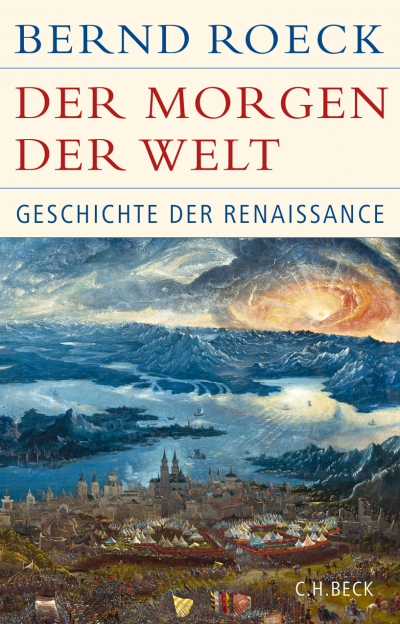
Der Morgen der Welt
Bernd Roeck (2017) · 1304 pages
Bernd Roeck’s Der Morgen der Welt is a large-scale history of the Renaissance that refuses to treat the period as a sealed Italian miracle. It moves from city politics and religious conflict to art, science, trade, and the wider world, tracing how a specific European condensation of ideas became a force with global consequences. Erudite without feeling inert, the book reads like a long walk through archives, streets, and workshops, with Florence often as a magnetic point but never as the whole story.
Why read
Because it offers the Renaissance as a living system rather than a postcard. Roeck gives you Tuscany’s brilliance without shrinking the era to beauty alone, and he explains why this moment matters for modernity in a way that stays intellectually satisfying long after the trip is over.
Schym
Rating
Some books do not ask to be consumed. They ask to be accompanied. Der Morgen der Welt belongs to that rare category of historical writing that is less an argument you finish than a landscape you repeatedly enter, each time noticing new contours. Roeck is not interested in the Renaissance as a sequence of genius portraits or museum highlights. He treats it as a structural turning point, the kind that quietly rearranges the conditions of thought, power, and self-understanding.
The scale is part of the method. This is a book that earns its weight by refusing shortcuts: politics is not decoration, religion is not a footnote, and the arts are not isolated from the material and intellectual infrastructures that made them possible. What emerges is a Renaissance that feels both familiar and newly contingent, anchored in Italian city life and yet constantly tugged outward by networks, conflicts, and exchanges that make “Europe” and “the world” inseparable even before the term globalisation becomes our own reflex.
As someone who returns to Tuscany, and especially to Florence, with a certain loyalty of the senses, I found the book unusually satisfying. It does not deny the gravitational pull of those places, but it also does not flatter the reader’s itinerary. Florence is present as a dense node, not as a shrine. The effect is almost corrective: admiration stays intact, yet it becomes sharper, because it is placed inside a larger explanation of why this period mattered, and why it still frames how modern people imagine freedom, knowledge, and culture.
The reading experience matches the subject. It is not an “evening” book, not built on narrative propulsion, and it does not pretend to be. Instead, the momentum comes from accumulation and linkage. You read a chapter, then you feel the desire to pause, not because it is exhausting, but because it quietly reorders your internal map of the era. There is a calm confidence in the prose and in the architecture of the material: Roeck trusts the reader to follow complexity, and he rewards that trust with clarity that never becomes simplification.
Verdict: five stars. A standard work on the Renaissance in the best sense of the word: comprehensive, intellectually serious, and richly companionable. Best suited for readers who want the most important period of early modern transformation laid out with breadth and precision, and who enjoy history as sustained attention rather than quick adrenaline.
historyrenaissancecultural history