CLIM-14 / SPM.B / Research primer
Where could summer heat and drying intensify together?
Do Central European regional projections show concurrent shifts in summer heat and moisture conditions across the same models and scenarios?
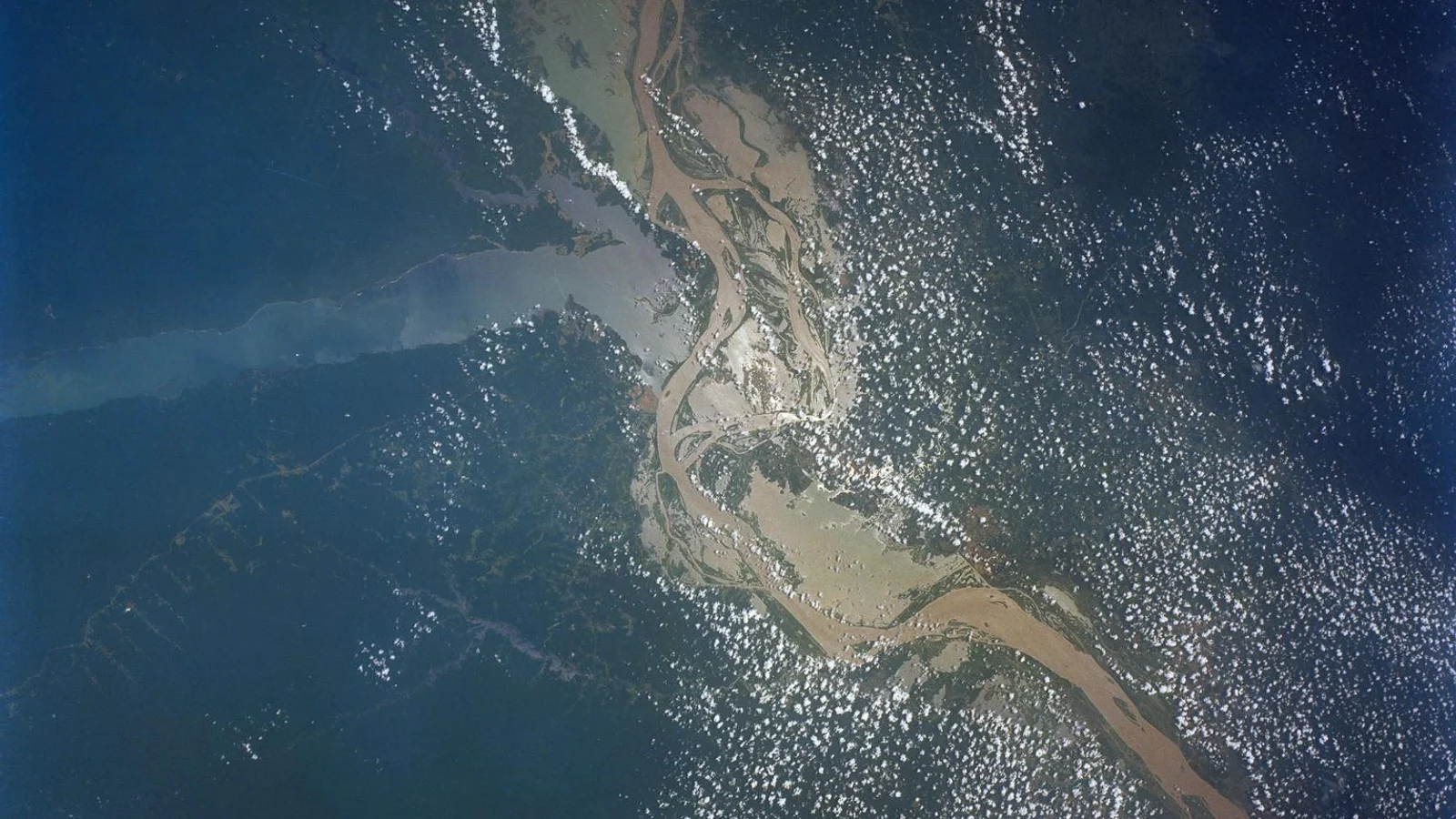
NASA/STS-43 crew. The Amazon and Tapajos rivers meeting near Santarem, Brazil, with forest and cleared land visible in a 1991 space photograph. Contextual image; not used to estimate a trend. Image credits.
The question
Changes in average heat and dryness are not automatically joint extreme-event probabilities. This study would establish what the compact exports actually support before discussing compound hazards.
Why it matters
Forestry, water management and agriculture need to distinguish a hotter average summer from simultaneous extremes that overwhelm several systems.
The AR6 anchor
AR6 assesses intensifying hazards and increasingly complex compound and cascading risks as climatic and non-climatic risks interact (high confidence).
AR6 Synthesis Report (2023) / B.1; B.2; B.4.
Evidence and comparison
- Unit of analysis
- Region-model-scenario-period; Bundesland-summer-year supplies a distinct historical comparison.
- Baseline and denominator
- Preserve Atlas native reference periods and drought definitions. Historical hot/dry classifications use predeclared 1991-2020 within-region thresholds, subject to complete observations.
- First descriptive test
- Compare projected shifts in temperature and moisture in matched regional panels; show historical German summer combinations without equating state and Atlas boundaries.
- Deeper analysis
- Count model agreement on concurrent mean shifts only if paired exports exist. Joint event frequencies require temporal joint data and remain unavailable otherwise.
- Attribution status
- projection/scenario analysis
- Uncertainty
- Retain ensemble spread and pairing information. Multiplying separate heat and drought probabilities would impose an unjustified independence assumption.
Principal sources
- Copernicus Interactive Climate Atlas
Summer temperature change; Precipitation or published drought indicator; Model and scenario identifiers.
Target 2041-2060 and 2081-2100; compact matched-model export checks pending. Candidate source; import and publication checks are still required. - DWD Climate Time Series
Summer mean temperature; Summer precipitation totals.
Target 1961-2025 complete summers; regional release checks pending. Candidate source; import and publication checks are still required.
Alternative explanations
- Soil and vegetation conditions
- Land management
- Scenario composition
- Spatial aggregation
The visual argument
Provisional: paired heat-moisture change plot with scenario selection; annotate matched-model counts and explicitly label mean shifts rather than joint-event probabilities.
- Historical German summer combinations
- Model-agreement panel
- Regional marginal distributions
- Indicator-definition comparison
What these data do not show
- Meteorological dryness is not measured tree mortality or crop loss.
- Compact marginal exports cannot establish compound-event frequency.
Reproducibility and next release
Plan src/build.mjs and data/processed/hot-dry-summers.csv from immutable data/raw aggregates; test seasonal completeness, model pairing, thresholds and geographic definitions, with queries, hashes and rights recorded in provenance.
- After approval: hot-dry summers study
- Article and dependence methods
- Responsive scenarios and exact values
- 16:9 hero and launch copy
- Optional PDF carousel
- Chart exports and compact scenario CSV