CLIM-12 / SPM.B / Research primer
Where could changing water stress challenge electricity systems?
Which countries combine projected changes in water stress with electricity mixes that warrant closer examination of water dependence?
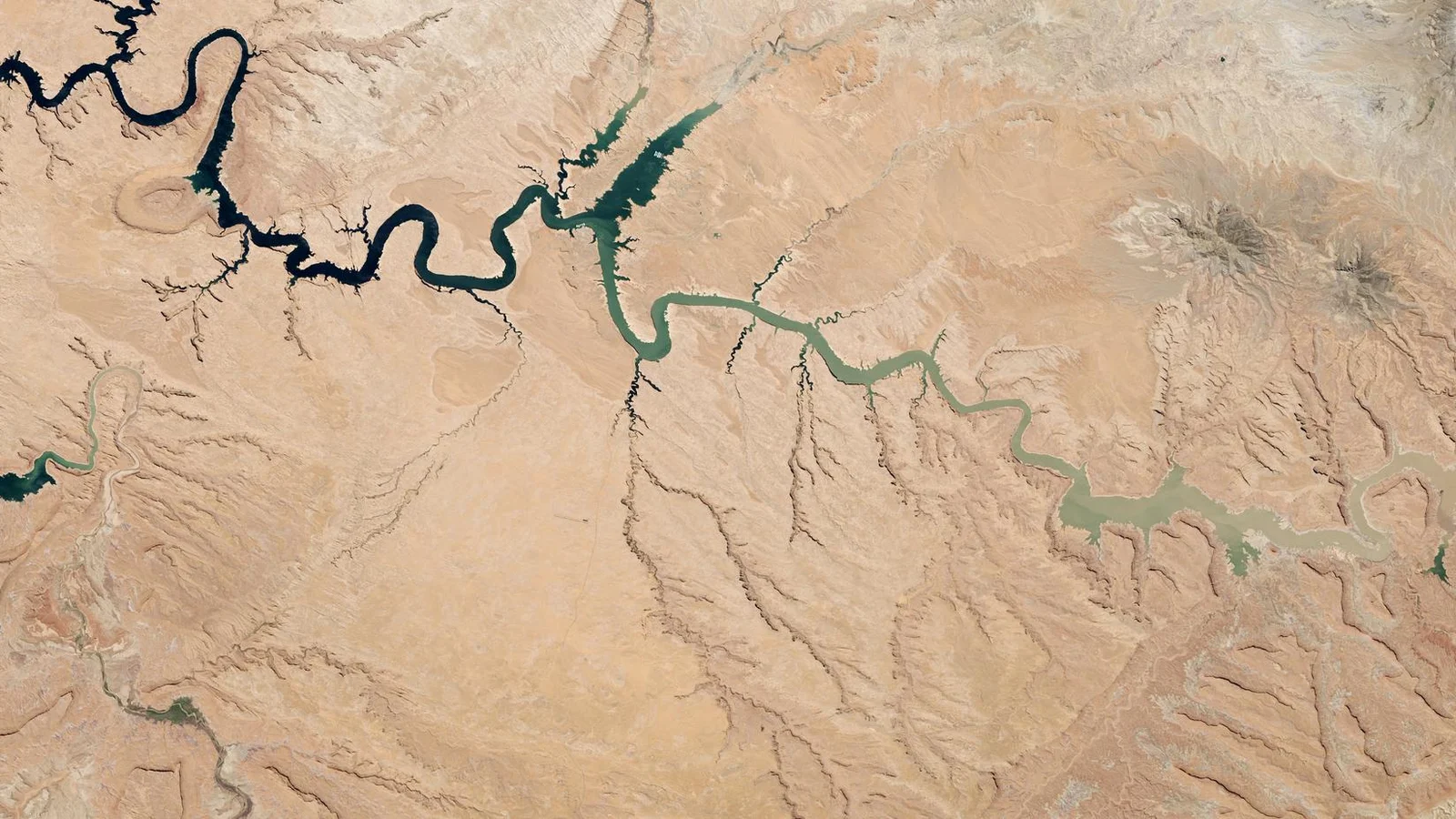
NASA Earth Observatory/Landsat. Landsat imagery of Lake Powell and its exposed shoreline in May 2014. Contextual image; not used to estimate a trend. Image credits.
The question
National water stress and generation mix can screen for possible adaptation questions. They cannot identify individual plant outages, cooling requirements or river-basin bottlenecks.
Why it matters
Energy planning can overlook water constraints when generation capacity is considered alone; the relevant exposure depends on technology, location and operating conditions.
The AR6 anchor
AR6 assesses growing interactions between climatic and non-climatic risks and declining effectiveness of some adaptation options at higher warming (high confidence).
AR6 Synthesis Report (2023) / B.2; B.4; C.3.
Evidence and comparison
- Unit of analysis
- Country-scenario-horizon linked to a separately dated electricity profile.
- Baseline and denominator
- Use Aqueduct's documented baseline and scenario assumptions; summarize electricity over a fixed five-year window where complete. Hydropower share is not cooling-water demand.
- First descriptive test
- Compare projected stress changes against hydro and thermal generation shares, showing these technologies separately rather than constructing an unsupported plant-risk index.
- Deeper analysis
- Test country classifications across available scenarios and alternative electricity windows; identify which comparisons would require basin or plant evidence beyond the authorized shortlist.
- Attribution status
- projection/scenario analysis
- Uncertainty
- Water projections combine climate and socioeconomic assumptions. Current generation shares describe exposure context, not the future electricity system or a probability of disruption.
Principal sources
- WRI Aqueduct 4.0
Baseline and projected water stress; Scenario; Projection horizon.
Target Aqueduct 4.0 baseline and 2030/2050 horizons; scenario export checks pending. Candidate source; import and publication checks are still required. - Ember Yearly Electricity Data
Generation by fuel (TWh); Hydropower share; Total generation.
Target 2019-2025 complete years; country coverage and release checks pending. Candidate source; import and publication checks are still required.
Alternative explanations
- Plant location and cooling technology
- Reservoir operations
- Electricity imports
- Future generation investment
The visual argument
Provisional: country comparison matrix with scenario and horizon controls; annotate native stress categories, electricity observation dates and missing plant-level information.
- Hydro and thermal mix profiles
- Scenario sensitivity intervals
- Generation-window comparison
- Basin-evidence dependency table
What these data do not show
- Country water stress cannot locate water-dependent facilities.
- No power-output loss or industrial economic damage is estimated.
Reproducibility and next release
Plan src/build.mjs to create data/processed/water-power.csv from immutable data/raw aggregates; provenance checks will validate scenarios, horizons, country joins, generation shares, units and redistribution permissions.
- After approval: water-power screening study
- Article and scenario boundaries
- Responsive profiles and exact values
- 16:9 hero and launch copy
- Optional PDF carousel
- Chart exports and screening CSV